

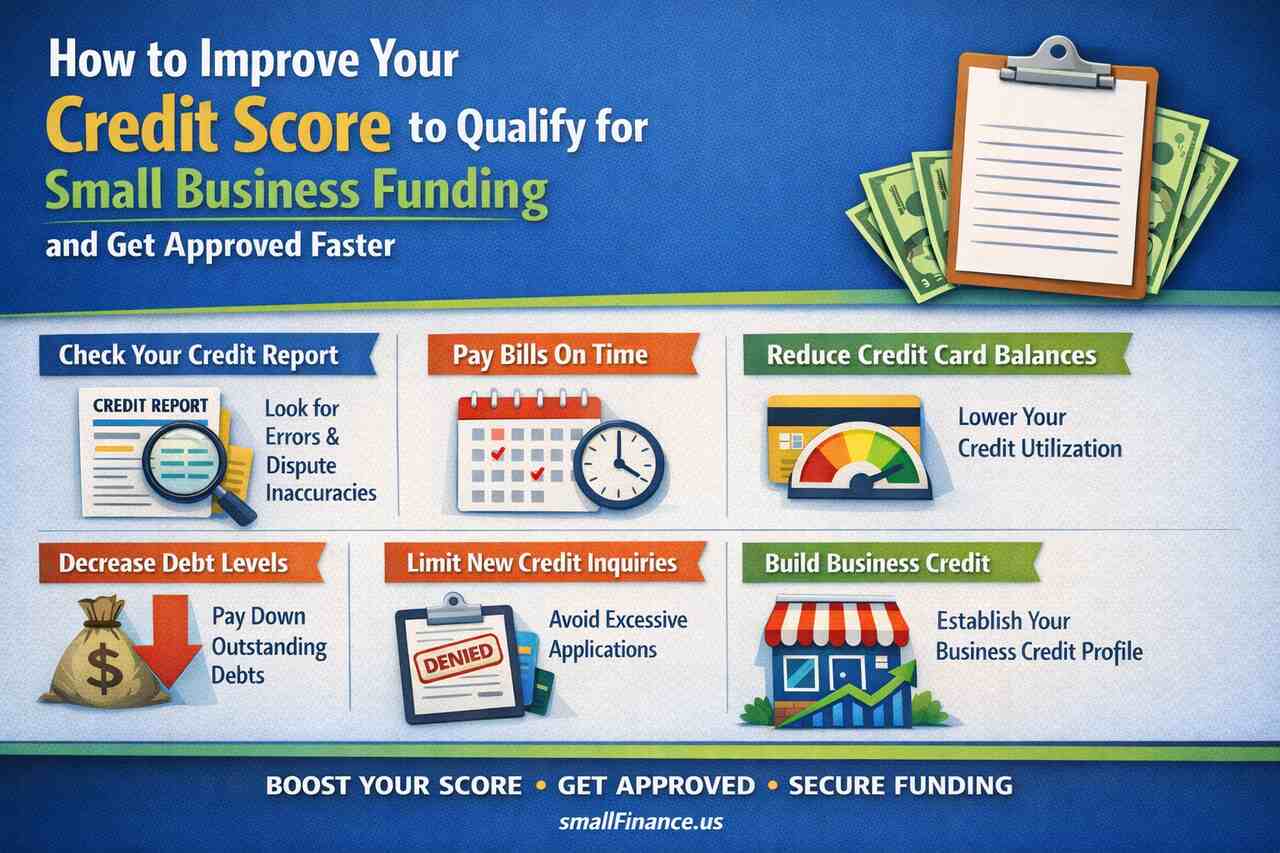
Highlights
- Learn how to raise personal and business credit scores to qualify for SBA and alternative small business loans.
- Understand the credit score requirements of banks, online lenders, and CDFIs.
- Discover key differences between FICO, VantageScore, and business credit scoring models.
- Identify and correct errors in your personal and business credit reports.
- Implement proven strategies to lower credit utilization and automate on-time payments.
- Use secured credit cards, vendor accounts, and builder loans to grow your credit profile fast.
- Compare the pros and cons of DIY vs professional credit repair services.
- Explore AI advancements in credit scoring and funding eligibility.
Understanding how to improve your credit score is essential for entrepreneurs who want to qualify for small business funding. A low credit score can prevent access to loans, delay approval processes, or increase financing costs. Whether applying for SBA loans, lines of credit, or merchant cash advances, business owners must actively manage and improve both personal and business credit profiles to meet lender requirements and reduce financial risk.
What Is a Credit Score and Why Does It Matter for Small Business Funding?
A credit score represents the risk level a lender assumes when issuing credit. For small business funding, lenders use credit scores to evaluate the financial responsibility of the business owner and the business entity. FICO and VantageScore are the primary scoring models used, each calculating scores based on different weightings of credit behaviors such as payment history, utilization ratio, and account age.
Lenders often use personal credit scores as a proxy for business responsibility, especially for new businesses. Poor credit may signal high risk, leading to rejected applications or high-interest offers. Scores above 680 typically qualify for most business funding options.
FICO Score Ranges:
- 800–850: Exceptional
- 740–799: Very Good
- 670–739: Good
- 580–669: Fair
- 300–579: Poor
Higher scores reduce funding costs and open access to more favorable financing options.
How Do Personal and Business Credit Scores Differ?
Personal credit scores reflect individual financial behavior, while business credit scores evaluate the creditworthiness of the business itself. Credit bureaus such as Experian, Equifax, and TransUnion handle personal scores, while business credit scores are managed by Experian Business, Dun & Bradstreet, and Equifax Business.
Key Differences:
- Data Sources: Personal scores are based on consumer credit cards and loans; business scores include trade lines, supplier credit, and business loan activity.
- Score Range: FICO personal scores range from 300 to 850. D&B PAYDEX ranges from 0 to 100.
- Public Visibility: Business credit reports are public and can be viewed by lenders, suppliers, and even competitors.
- Ties to EIN: Business scores are linked to an Employer Identification Number (EIN); personal scores are linked to a Social Security Number (SSN).
Business owners must manage both credit profiles because many lenders evaluate both when assessing funding eligibility.
What Are the Top Lenders’ Minimum Credit Requirements?
Minimum credit score requirements vary depending on the lender type. SBA loans often require scores of 680+, while alternative lenders may approve loans for scores as low as 500.
| Lender Type | Minimum Credit Score | Funding Type |
| SBA-Backed Lenders | 680+ | SBA 7(a), SBA Microloans |
| Traditional Banks | 700+ | Term Loans, Lines of Credit |
| Online Lenders | 500+ | Short-Term Loans, MCAs |
| Equipment Financing | 600+ | Equipment Loans |
| Peer-to-Peer Platforms | 640+ | Unsecured Loans |
Meeting these thresholds increases the chances of approval and access to favorable interest rates.
For entrepreneurs seeking quick approvals, online lenders offer flexibility, but often at higher costs compared to SBA-backed loans.
How Is a Business Credit Report Calculated?
Business credit reports are calculated using payment history, credit utilization, account age, credit mix, and public records. Dun & Bradstreet uses the PAYDEX score based on payment timeliness. Experian Business scores range from 1 to 100 and assess credit risk based on financial transactions.
Core Business Credit Score Components:
- Payment Timeliness: On-time payments to vendors and creditors weigh heavily.
- Account Diversity: Multiple types of credit lines (credit cards, trade credit, loans) improve profile strength.
- Credit Utilization: Lower usage indicates strong cash flow.
- Public Records: Bankruptcies, tax liens, and judgments reduce scores.
- Trade Lines: Positive vendor relationships contribute to credit history.
Business owners must regularly check their reports to ensure accuracy and completeness.
What Common Errors Appear on Credit Reports and How Can You Fix Them?
Common errors include incorrect balances, duplicate accounts, outdated data, or fraudulent activity. These inaccuracies can severely impact both personal and business scores.
Fixing Credit Report Errors:
- Step 1: Obtain reports from all bureaus (AnnualCreditReport.com for personal, NAV for business).
- Step 2: Review all listed accounts, balances, and payment dates.
- Step 3: Dispute errors in writing with supporting documentation.
- Step 4: Follow up within 30 days. Bureaus must respond or correct the information.
- Step 5: Request confirmation letters of corrections.
Business credit disputes can be initiated via D&B’s iUpdate, Experian Business, or Equifax Small Business portal.
How Can You Review and Understand Your Credit Reports?
Credit reports must be reviewed quarterly to identify score-affecting issues. Reports show the account history, payment behavior, credit limits, and derogatory marks.
How Often Should You Pull Your Credit Report?
Personal credit reports should be reviewed every 3 months. Business credit should be checked monthly via NAV or CreditSignal for early error detection and score monitoring.
What Should You Look For When Reviewing Your Credit?
When reviewing, focus on:
- Account accuracy (open/closed status)
- Payment history and late payments
- Utilization ratios
- Public records or collections
- Credit inquiries and new accounts
Correcting errors and adjusting behavior based on trends helps raise scores faster.
What Are Proven Ways to Lower Your Credit Utilization Ratio?
Credit utilization refers to the ratio between credit used and credit available. A lower ratio improves scores by demonstrating responsible usage.
Strategies to Reduce Utilization:
- Increase credit limits by requesting limit increases.
- Pay down revolving debt mid-cycle.
- Spread expenses across multiple cards.
- Use personal loans to consolidate high-utilization credit.
Maintaining a utilization ratio below 30% maximizes score benefits.
How Do On-Time Payments Impact Your Score and How Can You Automate Them?
Payment history is the largest factor in FICO scoring, accounting for 35% of the total. Consistent on-time payments signal low risk.
Automating On-Time Payments:
- Set up auto-pay through lender portals.
- Use accounting software like QuickBooks for recurring invoices.
- Schedule alerts for due dates.
- Maintain a financial buffer in business checking accounts.
Payment automation avoids late fees and preserves credit health.
How Can You Negotiate With Creditors to Remove Negative Marks?
Creditors may remove negative marks if a settlement is reached or a goodwill request is granted.
Negotiation Steps:
- Contact creditor directly to discuss account status.
- Offer lump-sum or payment plans in exchange for deletion.
- Submit goodwill letters for one-time late payments.
- Request updated reporting to bureaus post-payment.
Effective communication and written agreements increase the success of removals.
What Are Safe Ways to Build New Credit History Fast?
Building new credit fast requires strategic account openings and responsible usage.
Methods to Build Credit:
- Open secured business credit cards.
- Apply for store or fuel cards with low limits.
- Use business vendors that report to bureaus (e.g., Uline, Quill).
- Open credit-builder loans.
Avoid opening too many accounts at once to minimize hard inquiries.
How Do Secured Business Credit Cards and Loans Help Build Credit?
Secured cards and loans require collateral deposits, making them accessible to low-score applicants. These products report monthly and build positive payment history.
Benefits:
- Easier approval criteria.
- Reports to major business bureaus.
- Builds credit through small charges and full repayments.
- Converts to unsecured products with good behavior.
Secured financial tools create a low-risk path to credit growth.
Which Tools and Services Can Help Improve Your Credit Score?
Credit score improvement platforms provide alerts, insights, and identity protection.
What Are the Best Credit Monitoring Platforms for Small Business Owners?
Top platforms include:
- NAV: Tracks personal and business scores.
- Credit Karma: Offers personalized recommendations.
- Experian Business Advantage: Real-time alerts.
- D&B CreditSignal: Monitors business score changes.
Regular monitoring prevents unnoticed score declines.
When Is It Worth Paying for Professional Credit Repair?
Paid services are worth considering if:
- Disputes are complex and require legal understanding.
- Errors span multiple bureaus.
- Time is limited for DIY resolutions.
Look for services with NACSO accreditation and transparent pricing.
Where Can You Apply for Small Business Funding if Your Score Is Improving?
Entrepreneurs with improving scores can apply through:
- SBA-Approved Lenders for structured loans.
- Online Lenders for faster decisions.
- Community Development Financial Institutions (CDFIs) for mission-driven funding.
- Peer-to-Peer Networks for non-bank financing.
Each platform has varied requirements and turnaround times.
What Credit Score Improvement Services Are Legitimately Accredited?
Legitimate services include:
- Credit Saint (NACSO member)
- Lexington Law (Consumer advocacy and legal support)
- Sky Blue Credit (Flat-rate services)
What Are the Pros and Cons of DIY vs Professional Credit Repair Services?
| Option | Pros | Cons |
| DIY | Free, personalized, educational | Time-consuming, legally complex |
| Professional | Expertise, faster results, multiple disputes | Monthly fees, potential scams |
DIY works for simple corrections, while professionals suit complex credit profiles.
How Do Different Credit Scoring Models Impact Funding Eligibility?
FICO, VantageScore, and FICO SBSS models all assess credit differently. Lenders use varied models based on funding type.
Examples:
- FICO SBSS: Used by SBA lenders; considers both business and personal credit.
- VantageScore 4.0: Used by online lenders for quick assessments.
- Classic FICO: Preferred by banks for its conservative risk model.
Knowing the scoring model helps in optimizing score factors accordingly.
Which Lender Types Are Most Forgiving of Lower Credit Scores?
Alternative lenders are generally more flexible. Merchant cash advance providers, revenue-based lenders, and factoring companies focus on revenue and cash flow, not credit scores.
However, these options often involve higher costs and shorter repayment terms.
How Do You Check Your SBA Loan Eligibility?
Eligibility depends on:
- Business age (2+ years)
- Annual revenue ($100,000+ preferred)
- Owner’s personal credit (680+)
- Industry (not restricted by SBA)
Use SBA’s Lender Match Tool to check prequalification based on these criteria.
How Do You Contact Major Credit Bureaus to Dispute Errors?
| Bureau | Contact Method | Website |
| Equifax | Online/Form | equifax.com/business |
| Experian | Business Dispute Center | experian.com/small-business |
| D&B | iUpdate Portal | dandb.com/iupdate |
Provide supporting documentation and track responses.
What Common Credit Score Myths Could Be Hurting Your Funding Chances?
- Myth: Checking your score hurts it
- Fact: Soft inquiries do not impact scores
- Myth: Paying off collections deletes them
- Fact: Paid collections remain for 7 years
- Myth: Business credit doesn’t matter
- Fact: Lenders often evaluate both profiles
Believing these myths delays credit improvement efforts.
How Is AI Improving Credit Score Predictions and Funding Decisions?
AI analyzes broader datasets, including cash flow, online reviews, and behavioral patterns. Lenders now use AI to assess non-traditional credit indicators and offer funding to previously ineligible applicants.
AI Benefits:
- Fairer risk analysis
- Faster decision-making
- Predictive default modeling
- Expanded access for thin-file applicants
AI models enhance scoring accuracy and expand funding access.
Conclusion
Improving your credit score requires a multi-faceted approach involving monitoring, dispute resolution, responsible usage, and strategic borrowing. Entrepreneurs who understand both personal and business credit systems can unlock a wider range of funding opportunities, reduce interest rates, and achieve long-term financial growth.
FAQs
Q: What credit score do I need for small business funding?
A: A score of 680+ qualifies for SBA and traditional bank loans. Alternative lenders may accept lower scores.
Q: Can business credit improve if my personal credit is poor?
A: Yes, business credit builds independently through vendor lines, credit cards, and trade accounts.
Q: How often should I check my business and personal credit reports?
A: Check personal credit quarterly and business credit monthly.
Q: Will paying off collections raise my score fast?
A: Scores may improve slightly, but paid collections still appear on reports.
Q: Are secured business credit cards worth it?
A: Yes, they provide a safe way to build credit with low approval barriers.
Q: How long do negative marks stay on my credit report?
A: Most derogatory marks remain for 7 years unless successfully disputed.
Q: Can a co-signer help me qualify for business funding?
A: Yes, co-signers with good credit improve your chances for approval.
Q: What mistakes should I avoid when repairing credit?
A: Avoid closing old accounts, applying for too many new accounts, or using credit repair scams.
