

Highlights:
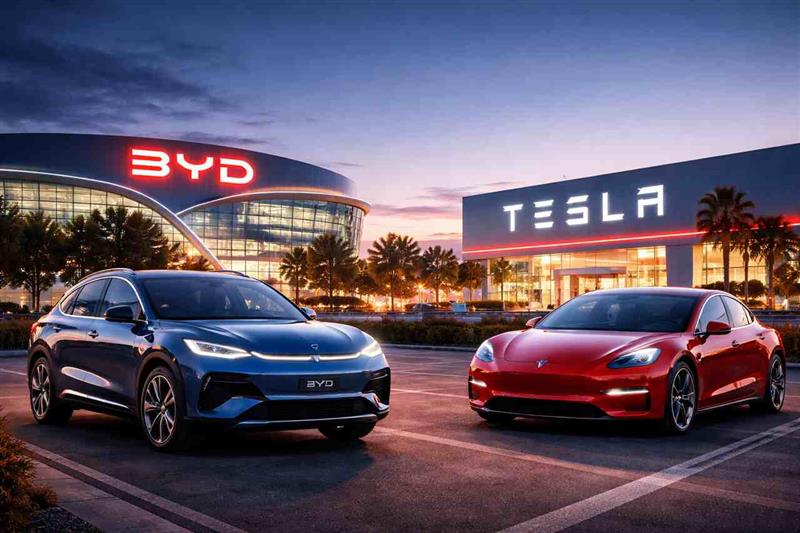
- BYD overtook Tesla in Q4 2025 global BEV sales, delivering 526,000 units vs Tesla’s 484,000 marking the first time Tesla lost the top quarterly position in EV sales.
- China’s domestic EV demand fueled BYD’s volume; over 80% of BYD’s sales came from its home market, boosted by subsidies and local infrastructure.
- BYD’s vertically integrated supply chain, including in-house Blade Battery production, gave the company speed and cost advantages over Tesla’s outsourced components.
- BYD’s diversified EV lineup (e.g., Seagull, Dolphin, Han EV) outperformed Tesla’s limited model range in appealing to various buyer segments.
- Global expansion through regional manufacturing (Brazil, Thailand) and smart government partnerships accelerated BYD’s international growth.
- Tesla retains dominance in the U.S. and software ecosystem, with strengths in FSD, energy integration (Powerwall, solar), and upcoming low-cost EV platform for 2026.
- BYD’s rise signals China’s increasing control over EV standards, technology, and supply chains, potentially shifting long-term industry leadership.
- Tesla’s counter-strategy includes a $25K model, next-gen autonomy, and global gigafactory expansion to reassert its position by 2026.
How Did BYD Outperform Tesla in Global EV Sales?
BYD’s Q4 2025 Sales Surpassed Tesla’s Deliveries
BYD delivered over 526,000 fully electric vehicles (BEVs) in Q4 2025, outpacing Tesla’s 484,000 global deliveries. The sales surge positioned BYD as the top global EV seller for the quarter. While Tesla maintained its lead for the full year, the quarterly win marked a pivotal shift in market dynamics.
Domestic Market Dominance Amplified BYD’s Output
China’s vast domestic EV demand enabled BYD to scale operations effectively. Over 80% of BYD’s sales originated in China, supported by government subsidies, competitive pricing, and expanding charging infrastructure. Tesla’s reliance on exports from Giga Shanghai limited its growth margin in comparison.
Vertical Integration Strengthened BYD’s Supply Chain
BYD controls its entire manufacturing ecosystem, including battery production (Blade Battery), semiconductor supply, and electric drivetrain development. This vertical integration reduced operational bottlenecks and enhanced scalability, while Tesla faced periodic supply chain challenges.
Product Diversification Increased BYD’s Reach
Unlike Tesla’s narrow product range, BYD offers more than 10 electric models across varying price brackets and body types. Models like the Seagull, Han EV, and Dolphin catered to broader market segments, increasing buyer accessibility in both domestic and international markets.
Export Strategy Accelerated BYD’s Global Footprint
BYD expanded into Europe, Southeast Asia, and Latin America with aggressive pricing and local partnerships. In 2025, BYD opened assembly plants in Brazil and Thailand, ensuring competitive delivery timelines and bypassing export tariffs, thus gaining a strategic edge over Tesla’s export-heavy model.
What Key Factors Are Driving BYD’s Market Expansion?
Price-Value Balance Attracted Cost-Conscious Buyers
BYD’s vehicles offered a lower cost-per-kilometer ratio than Tesla, with prices starting around $10,000 for entry-level models like the Seagull. Combined with consistent safety ratings and smart features, this value proposition appealed to mass-market consumers.
Localized Production Lowered Costs and Delivery Times
BYD’s establishment of regional manufacturing hubs enabled faster delivery and minimized logistics costs. The Thailand plant served Southeast Asian markets, while the Brazilian facility targeted South America, allowing region-specific customizations and tariff advantages.
Technological Innovations Improved Energy Efficiency
The Blade Battery, a proprietary lithium iron phosphate (LFP) solution developed by BYD, offered higher energy density and safer thermal performance. Compared to Tesla’s 4680 battery cells, Blade Batteries demonstrated faster charge cycles and lower degradation rates in real-world tests.
Government Partnerships Boosted Global Entry
In several developing markets, BYD partnered with governments to supply electric buses and taxis, establishing early brand familiarity. These collaborations fostered long-term loyalty and allowed seamless expansion into the personal EV segment.
After-Sales Ecosystem Reinforced Consumer Trust
BYD invested heavily in digital servicing platforms, spare part logistics, and financing solutions, enhancing the post-purchase experience. Tesla, although technologically advanced, often drew criticism for long service delays and limited physical support centers outside the U.S.
How Does Tesla Plan to Counter BYD’s Momentum?
Next-Gen Platform Expected to Lower Tesla’s Price Point
Tesla’s upcoming $25,000 compact car, based on the next-gen platform, is aimed at regaining dominance in the affordable EV segment. Elon Musk announced mass production would commence in late 2026, targeting price-sensitive regions like India and Southeast Asia.
Software Superiority Remains Tesla’s Key Differentiator
Tesla continues to lead in Autopilot, Full Self-Driving (FSD) development, and over-the-air software updates. While BYD’s DiPilot system is advancing, Tesla’s AI training infrastructure offers a clear edge in autonomous capabilities and user interface design.
Energy Ecosystem Integration Drives Long-Term Strategy
Tesla’s solar roof, Powerwall, and vehicle-to-grid (V2G) integrations position the company within a broader clean energy ecosystem. This alignment with residential energy independence could offer long-term value beyond the EV market, something BYD is only beginning to pursue.
North American Market Retention Remains Critical
Tesla’s stronghold in the U.S. continues unchallenged. BYD has no immediate plans for consumer EV sales in the U.S., partly due to geopolitical tensions and tariff barriers, allowing Tesla to retain dominance in its home market with minimal competition.
Cybertruck Launch Repositions Tesla Brand Identity
The release of the Cybertruck, although niche, reinforces Tesla’s innovative image. With exoskeleton design, range exceeding 500 miles, and adaptive suspension, Tesla differentiates itself from mass-market competitors like BYD through bold product experimentation.
What Are the Broader Implications for the Global EV Industry?
China’s Influence on Global EV Standards is Growing
BYD’s rise reflects a broader shift of EV innovation to China, where cost efficiency meets high-volume production. Global standards for battery architecture, charging protocols, and vehicle connectivity are increasingly being shaped by Chinese manufacturers.
EV Market Fragmentation is Accelerating
Tesla’s previous dominance gave the impression of a monolithic EV leader, but BYD’s emergence introduces healthy competition. Other players like NIO, Xpeng, and Hyundai are also expanding rapidly, creating a multi-polar EV ecosystem.
Government Policies May Realign Market Balance
The U.S. Inflation Reduction Act, European Union Green Deal, and China’s NEV credit policy are reshaping EV subsidies and supply chains. These frameworks will influence which companies can maintain scale and profitability across borders.
Battery Technology Becomes the Prime Battleground
Innovation in solid-state batteries, sodium-ion cells, and recycling will determine future leadership. Both Tesla and BYD are investing in next-gen chemistries, but Chinese firms currently lead in supply chain control and upstream material access.
Consumer Behavior Is Pivoting Toward Affordability and Accessibility
As EV adoption matures, early tech adopters give way to budget-conscious, utility-driven consumers. BYD’s strategy aligns closely with this shift, while Tesla may need to recalibrate brand positioning to balance luxury perception with mass-market appeal.
