

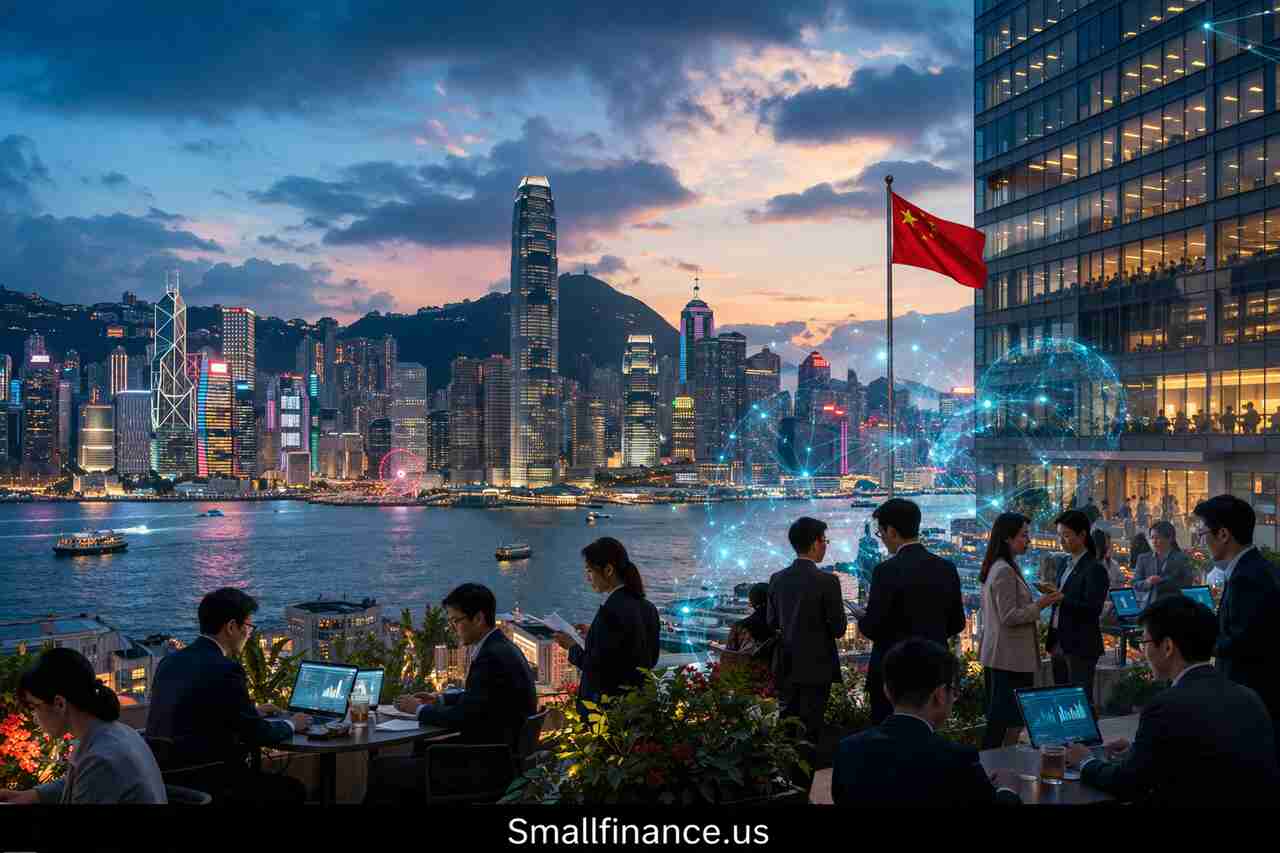
One of the lift doors opens, and a guest comes out. This happens in the lobby of a hotel on Hong Kong Island. The robot waits, and then it rolls inside in a neat way.
It looks easy, but the move isn’t. The hotel is very busy and is part of a foreign chain. The robot has to find its way through a building that won’t stop for it.
Along the way, many people get in the way. The lift needs to go to the right floor, and then it needs to find the right room.
Yunji, the company that made the robot, is a mainland Chinese tech company that wants to use Hong Kong as a launching pad for successful foreign growth.”Our goal is for our product to do well in Hong Kong and then spread to other places,” says Xie Yunpeng, vice-president of the company.
Tech companies from mainland China are seeing Hong Kong as an important place to raise money, test goods with customers from other countries, and build credibility before going global.
This is important because countries in the US and Europe are becoming more wary of Chinese companies like these. Some critics call it the “China risk”: countries are afraid of state-led spying and Chinese companies taking over too much of their tech sectors.
It means that mainland Chinese tech companies are having a harder time getting money, customers, and trust in some foreign markets. On the other hand, they are first looking to Hong Kong.
There were 30 mainland Chinese companies listed on the Hong Kong Stock Exchange in 2024, but there were 76 last year, up 153%. This is according to a study by the big accounting firm PricewaterhouseCoopers.
Invest Hong Kong, the special administrative region’s investment promotion office, has also seen a rise in the number of mainland companies it has helped set up or grow in the territory. Technology and innovation are two of the biggest industries these companies are working in.
Dr. Xiaomeng Lu, who works for the political consulting firm Eurasia Group, says that mainland Chinese tech companies are “shifting to Hong Kong” for their main share listing because “geopolitical headwinds dampen their dreams” to go public in New York.”These days, Hong Kong is their best chance to get investors from around the world and set themselves up as a player who isn’t fully limited by the mainland market,” she says.
Wendy Chang of the Mercator Institute for China Studies, a think tank in Germany, says that Hong Kong is “fashioning itself as a connector to the outside world for Chinese companies.” This is because of policies that help mainland companies set up operations in the city and speed up the listing of shares.
The Chinese government in Beijing wants the country to become more “technology self-sufficient,” which is why they are paying more attention to Hong Kong.
Its main economic goal now is to significantly lower its reliance on foreign hardware and software, especially when it comes to AI and chips.
This is a big part of the country’s new 15th Five-Year Plan. The plan sees technology as both an economic and a strategic goal, since the country is having trouble getting along with the US.
Paul Triolo, a partner at the global business consulting firm DGA Group in Washington, D.C., says that this has made the “strategic value of Hong Kong for high-tech Chinese companies” rise.
Chief economist for Asia-Pacific at French investment bank Natixis, Alicia Garcia-Herrero, says that mainland companies can show that they can meet international standards in Hong Kong. This helps them build trust with investors and customers around the world.
For Yunji, that means showing that its robots can work in real-life foreign situations. The company listed in Hong Kong in October of last year to get more investors from outside of mainland China. It makes service robots for hotels, hospitals, and workplaces.
In the same month, a Chinese company called MiningLamp Technology set up shop in Hong Kong. Wu Minghui, the company’s founder, says that Hong Kong is like a “data compliance transfer station” because it’s where mainland Chinese companies can try out how to handle data flows across borders and set up compliance systems before they go into other markets.
But even if a mainland Chinese company does well in Hong Kong, it might still have trouble doing business in other countries.
Concerns about data access and vital infrastructure have led governments in the US and Europe to tighten their national security reviews of Chinese investments and technology. The US and UK are two other countries that have taken steps to limit or get rid of Chinese telecoms sellers.
Western countries are also worried about how Chinese companies are run and how open they are. Many foreign investors are still learning from the Luckin Coffee scandal, even though the Chinese company admitted to making up sales.
Because of the news, the company’s shares were taken off of the Nasdaq stock market in New York in 2020.
Also, Hong Kong isn’t as appealing to investors and companies from other countries as it used to be. Since the 2019 pro-democracy protests, the government has put in place a broad national security law and new local security laws.
Dozens of activists, journalists, and lawmakers from the opposition have been jailed or arrested under security laws and other acts. Government officials in Beijing and Hong Kong say the steps were needed to restore peace and order, but critics say they have severely limited democratic freedoms.
Triolo says that many mainland companies, even those with a base in Hong Kong, still have to follow the changing rules made in Beijing. These rules cover everything from cybersecurity and data controls to standards for AI that is used by the public.”Hong Kong is not really a geopolitical shield for these kinds of companies,” he says, adding that it “only partially mitigates” their risks.
