

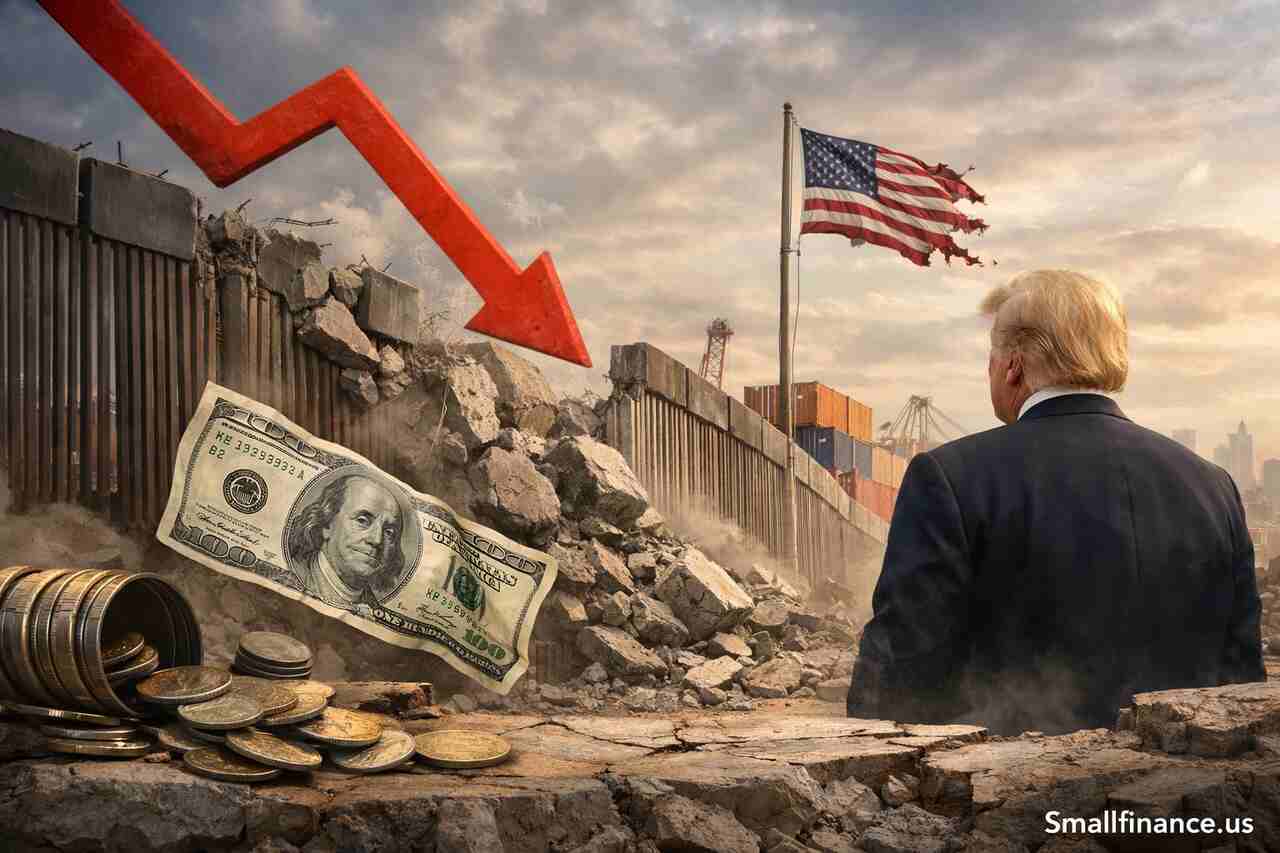
Traders thought that the U.S. Supreme Court’s decision to throw out most of President Donald Trump’s tariffs was good for global growth, so the dollar fell on Monday. However, small changes were limited by uncertainty and the risk of war in the Middle East.
The euro went up 0.4% to $1.1823 and the pound went up by the same amount to $1.3521 early in Asia trade. Japan was on holiday and China was celebrating the Lunar New Year, which slowed down trade a bit. The dollar dropped to 154.42 yen, a 0.4% drop.
On Friday, the Supreme Court said that Trump’s broad taxes went beyond what he was allowed to do. In response, Trump slammed the court and put a 15% tax on all goods. He also insisted that trade deals with other countries that have higher tariffs should stay in place.
“It weakens the dollar because it could help growth outside of the U.S.,” said Sim Moh Siong, a currency analyst at Singapore’s OCBC Bank.
He said that the longer-term effects on foreign exchange were less clear. A drop in U.S. income could be bad for the budget and the dollar, but a limit on Trump’s power could be good because it would stop a source of policy instability.
In morning trade, both the Australian and New Zealand dollars were a little higher. The Australian dollar went over 71 cents, and the kiwi was just below 60 cents.
The safe-haven Swiss franc went up by 0.5% to 0.7716 francs per dollar.
Mr. Wong, a strategist at BNZ in Wellington, said, “This decision takes away more of Trump’s power, which is good for the markets.”
“But there are so many things that can go wrong, it can’t be traded.”
The markets are also paying attention to the U.S. military buildup in the Middle East as a way to put pressure on Iran to stop its nuclear weapons efforts. They are also looking forward to Trump’s State of the Union speech on Tuesday.
It’s not clear if the U.S. pays importers refunds on duties already paid because the Supreme Court hasn’t made a decision on the matter. Trump’s replacement levies are in place for 150 days.
Analysts think that there will be years of lawsuits and more confusion while Trump looks for other ways to fully replace the huge number of global tariffs.
He said, “Things don’t change too much.” Martin Whetton is the head of financial markets planning at Westpac in Sydney.
On Sunday, the European Commission asked the U.S. to follow through on a deal it made with the EU last year. That deal includes no taxes on some goods, like planes and spare parts.
Asian trading partners of the U.S. were cautiously weighing new unknowns, as were investors who had already been caught off guard by how markets reacted to Trump’s trade tariffs, which, by the way, have not closed the U.S. trade gap.
Before Trump was elected, investors bet that tariffs would make the dollar stronger because they thought that other countries would try to weaken their currencies to make up for the loss of exports.
Markets were more interested in expecting interest rate cuts, worried about the U.S. budget deficit, and Trump’s unpredictable policy changes, so the dollar fell until 2025. The dollar index fell more than 9%.
ANZ’s group chief economist Richard Yetsenga said on the bank’s podcast, “The main issue is that the Trump administration will have a lot less freedom to use tariffs in general.”
“I don’t think this will make the world economy change that much.”
Read Next :
Trump Currency Policy Remarks Trigger Multi-Billion Dollar Losses in Gold and Silver Markets
