

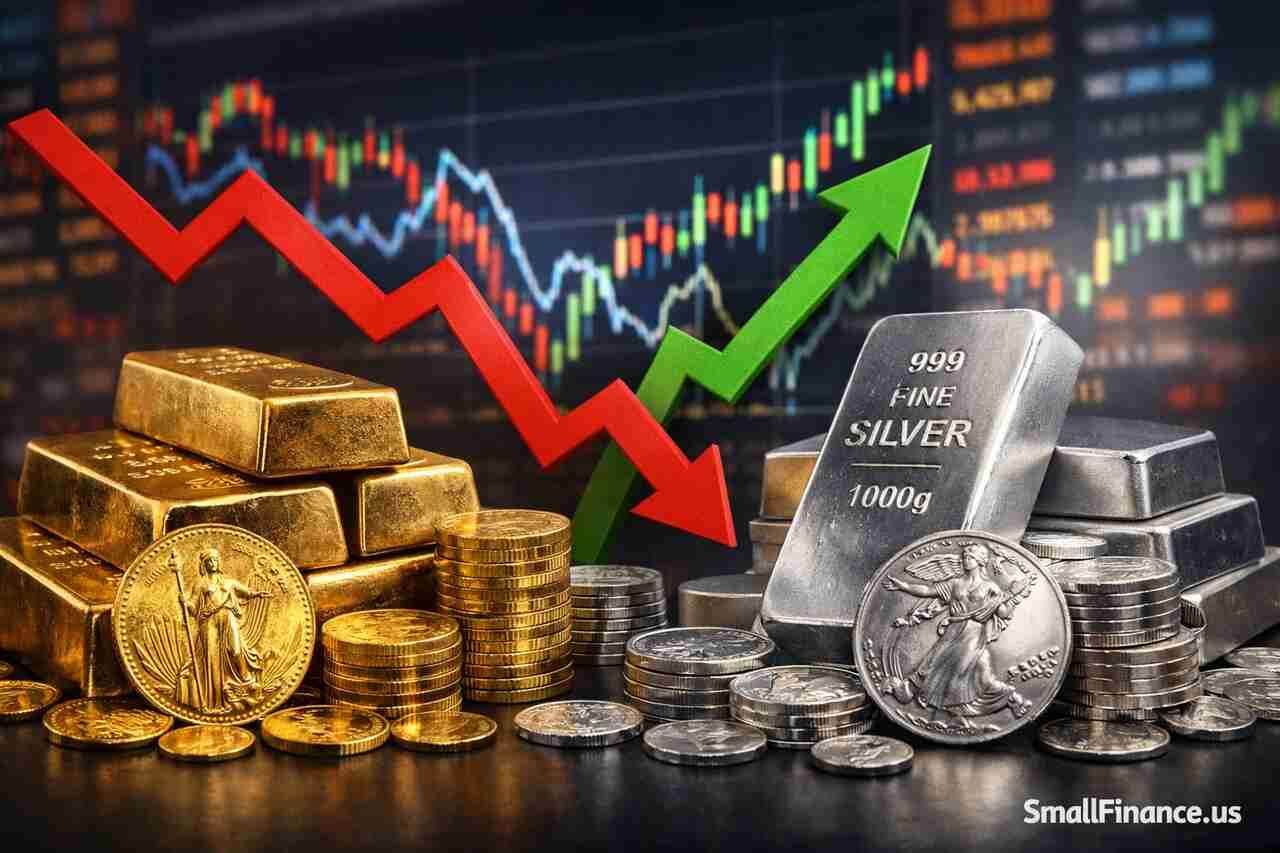
What Triggered the Historic Collapse in the Gold and Silver Markets?
Excessive speculative trading pressure destabilized both gold and silver prices. Institutional leverage from hedge funds and algorithmic trades inflated short-term price peaks, which were unsustainable. When macroeconomic indicators shifted, especially interest rate hikes and stronger USD indexes, investors began rapidly liquidating positions.
Federal Reserve monetary policy reversals introduced systemic uncertainty. As expectations for rate cuts diminished in early 2026, treasury yields spiked. Since gold and silver function as non-yielding safe-haven assets, their opportunity cost increased dramatically, prompting outflows from ETFs and futures.
Chinese industrial demand for silver declined abruptly due to manufacturing contraction. China’s Purchasing Managers’ Index (PMI) revealed contraction in electronics and photovoltaic sectors, both major consumers of silver. This created a sharp imbalance between expected demand and actual consumption.
Record-high Comex warehouse inventories pressured spot markets. Unprecedented stockpile growth in Comex and LBMA storage led to fears of oversupply, breaking investor confidence and causing price dislocations between futures and physical delivery contracts.
Retail panic and margin calls fueled the chain reaction. Following flash crashes on key exchanges, smaller retail investors, especially in Asia and Europe, received margin calls, intensifying the downward momentum. This culminated in historic intraday price drops for both gold and silver.
How Are Gold and Silver Prices Attempting to Stabilize?
Central bank interventions are absorbing strategic gold reserves. Nations like Turkey, India, and Kazakhstan have resumed gold purchases to hedge against geopolitical risks and stabilize currency reserves, providing floor support for bullion prices.
Precious metal-backed ETFs are seeing cautious inflows. Despite the crash, platforms like SPDR Gold Shares (GLD) and iShares Silver Trust (SLV) reported minor inflows, indicating returning retail and institutional confidence in a long-term value thesis.
Industrial buyers are negotiating new long-term silver contracts. Manufacturers in renewable energy and electronics sectors are renegotiating procurement terms, reintroducing baseline industrial demand for silver after the initial shock.
Refiners and bullion dealers are reducing premiums to stimulate physical sales. By narrowing bid-ask spreads and lowering coin or bar premiums, wholesalers aim to boost physical market activity, helping stabilize broader sentiment.
Technical chart signals show resistance and consolidation zones. Technical analysts identify key Fibonacci retracement levels and RSI reversals in gold at $1,975 and silver at $22.40 that suggest bottoming behavior, guiding short-term trading decisions.
What Are the Economic Implications of the Precious Metals Volatility?
Investor confidence in commodity hedging strategies has been undermined. Long-trusted risk-off assets like gold are now viewed with caution, especially by pension funds and sovereign wealth managers who rely on low-volatility hedges.
Global inflation expectations may be misinterpreted due to precious metals decoupling. Historically, gold prices signal inflationary trends. The crash introduces noise into inflation models, potentially misguiding central bank responses.
Mining sector equity valuations have collapsed. Companies like Newmont Corporation and Pan American Silver saw double-digit percentage declines in equity value, impacting broader indices such as the NYSE Arca Gold Miners Index (GDM).
Emerging markets with high gold reserve ratios face fiscal instability. Nations like Ghana and Venezuela, which rely on gold exports or store value in bullion, now face fiscal shortfalls and currency devaluation threats.
Derivatives markets face higher collateralization demands. Due to increased volatility, clearing houses now require higher margin reserves, affecting liquidity across broader commodity and forex trading networks.
What Are Experts Predicting for Gold and Silver in Q2 and Beyond?
Gold is expected to rebound moderately if the USD weakens. Analysts at JP Morgan and UBS foresee a price recovery toward $2,050 if the U.S. dollar index (DXY) retraces and the Fed softens its stance by May 2026.
Silver’s trajectory hinges on photovoltaic and EV demand recovery. If China’s solar infrastructure expansion resumes and U.S. EV incentives continue, silver may climb back toward its $24.80 resistance level.
Geopolitical tensions could reintroduce haven demand. Escalations in Middle East or Eastern European conflicts could catalyze renewed interest in precious metals as geopolitical hedges.
Retail investor sentiment may drive volatility through platforms like Reddit and eToro. Memetic trading behavior, especially among Gen Z and millennial investors, could either support rapid rebounds or cause erratic price swings.
Supply chain dynamics in mining and refining are under close watch. Any disruption in South African, Peruvian, or Canadian mining operations could lead to sudden supply constraints, reversing oversupply narratives.
Why Are Gold and Silver Still Relevant in Modern Portfolios?
Gold remains a core asset for sovereign monetary reserves. Central banks maintain gold as a non-correlated hedge against fiat depreciation and monetary policy uncertainty, cementing its long-term relevance.
Silver’s duality as a precious and industrial metal enhances diversification. Silver provides both store-of-value and exposure to industrial growth, especially in green technologies, making it essential for forward-looking ESG portfolios.
Both metals offer protection against systemic risk and black swan events. In times of war, economic collapse, or financial contagion, physical gold and silver often outperform paper-based or digital-only assets.
Precious metals offer a hedge against negative real interest rates. When inflation-adjusted returns on bonds turn negative, gold and silver regain prominence as wealth-preserving tools.
Investor preference for tangible, non-digital assets is resurging. Amid digital asset volatility and cybersecurity concerns, physical gold and silver satisfy demand for secure, tangible stores of wealth.
