

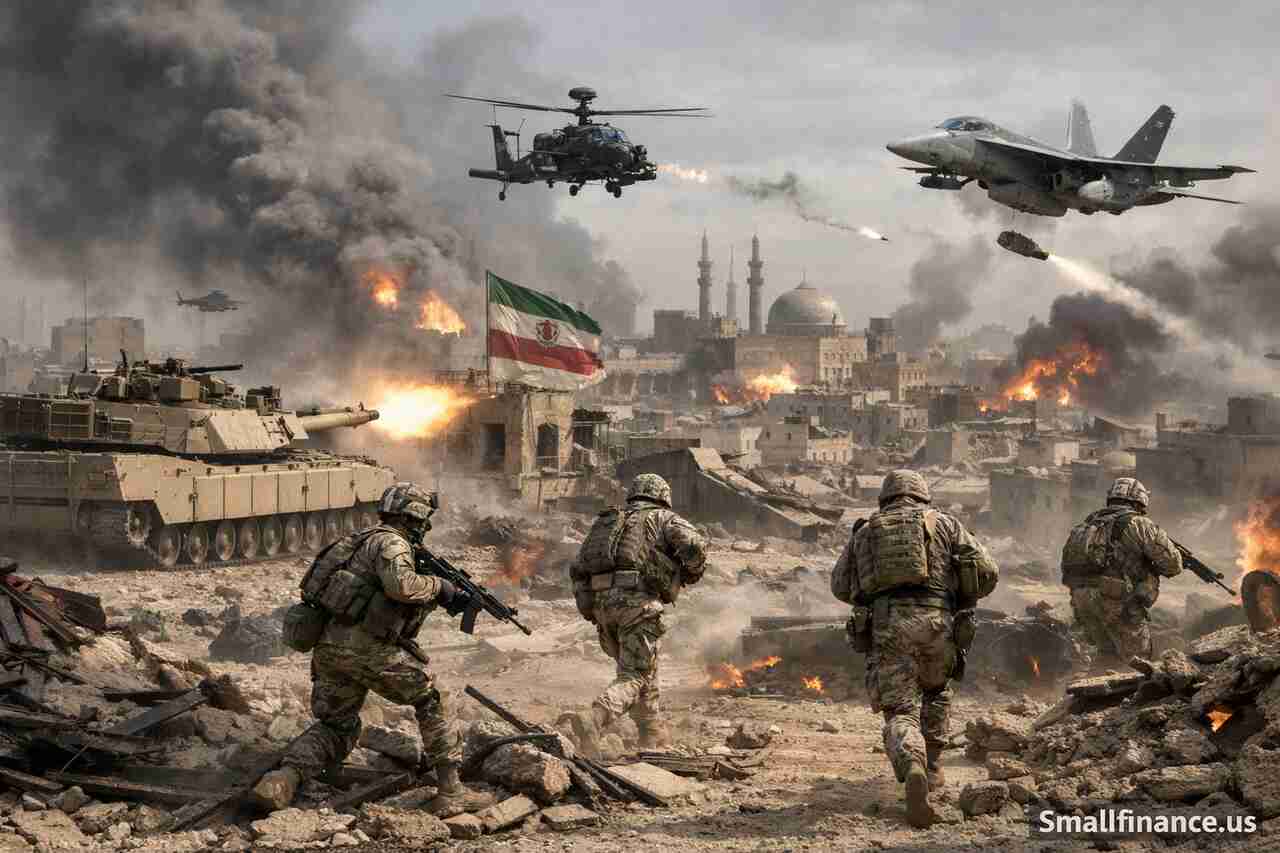
The assaults follow Trump’s leadership of a significant Middle East military buildup and negotiations with Tehran to reach a new agreement to limit Iran’s nuclear program.
As Israeli and American forces launched strikes on the Middle Eastern country early Saturday, President Donald Trump said in a video message that American forces had started “major combat operations” in Iran.
According to a U.S. official who spoke to NBC News, Iran quickly started retaliating against many American military installations throughout the Middle East.
The attacks by the United States and Israel follow Trump’s leadership of a significant military buildup in the area and negotiations with Tehran to reach a new agreement to limit Iran’s nuclear program.
In the statement posted on Truth Social, Trump stated, “We repeatedly sought to make a deal.” “We made an effort.”
On the scene, an NBC News producer reported hearing the unceasing roar of explosions in Tehran. Tasnim, Iran’s semi-official news agency, said earlier that Iran had declared it was suspending its airspace, and news agency footage showed smoke billowing over the buildings.
In an eight-minute video address posted on Truth Social, Trump stated, “Our goal is to protect the American people by removing the Iranian regime’s immediate threats.””Bombs will be dropping everywhere,” he continued, speaking directly to Iranians. “Take over your government after we’re done. You will be able to take it.
The U.S. was conducting the military action from both the air and the water, according to two U.S. sources who spoke to NBC News. According to one of the authorities, the operation involved a wide variety of fighter jets. According to the other official, the United States is focusing on security and military objectives.
Trump added that while the administration was taking “every possible step” to reduce the risk to U.S. forces, “courageous American heroes may be lost and we may have casualties.”
In conflict, that frequently occurs,” he continued.
According to Bahraini State News Agency BNA, a missile attack occurred on Saturday against the U.S. Fifth Fleet’s service center in Bahrain.
Whether there were any victims was not immediately apparent.
All government workers and their families have been urged to remain indoors until further notice by the U.S. embassy in Jerusalem.
Prior to the strikes, Iran threatened to target Israel and American bases around the area, vowing to react against any attack.
Israel had already “launched a preemptive strike” against Iran, according to a spokesman for the country’s defense minister. A later statement from the military claimed to have “identified missiles launched from Iran toward Israel.”
In a statement, Israeli Prime Minister Benjamin Netanyahu hailed Trump for his “historic leadership” and said that his nation and the United States had “embarked on an operation to remove the existential threat,” alluding to Iran.
As the area still reels from the Israel-Hamas war in the Gaza Strip, other Middle Eastern countries have warned that any attack could turn into another big battle.
After authorities clamped down on massive statewide protests that began in December and January over Iran’s failing economy but turned into calls for the removal of the Islamic system, Trump threatened to strike the country.
Thousands were killed and tens of thousands more were arrested in the weeks that followed the regime’s suppression of the protests.
Then, if an agreement could not be reached with Tehran regarding its nuclear program, which the president had claimed the U.S. “obliterated” with attacks in June, Trump threatened a military assault. Only one of the three targeted locations was destroyed, according to a subsequent U.S. assessment.
In a more recent statement, the administration said that Iran was working to revive its nuclear program, that it may have enough fissile material for an atomic weapon in “a week,” and that it could soon be able to attack the United States with its ballistic missiles. There isn’t any publicly accessible proof that Iran has significantly advanced its damaged nuclear program, particularly whether it has started uranium enrichment again. Iran has not been officially charged by the Trump administration with resuming its uranium enrichment activities.
Demands to stop uranium enrichment or extend negotiations to cover Iran’s ballistic missile program and support for proxy forces around the Middle East are met with resistance from Iran, which has consistently maintained that it has not sought nuclear weapons.
The United States gathered troops and strengthened its air defenses at bases throughout the region while negotiating with Iran.
At the head of what he called a “armada,” Trump dispatched the largest aircraft carrier in the world, the USS Gerald R. Ford, to join another.
The United States and other international powers have already inked a nuclear agreement with Iran. Supporters viewed the 2015 Joint Comprehensive Plan of Action, or JCPOA, as a historic deal that gave transparency and international assurance that Tehran was not developing nuclear weapons.
However, Trump and other detractors viewed the agreement as inadequate and asserted that it would merely postpone Iran’s acquisition of a weapon. Trump unilaterally pulled the United States out of the deal in 2018.
