

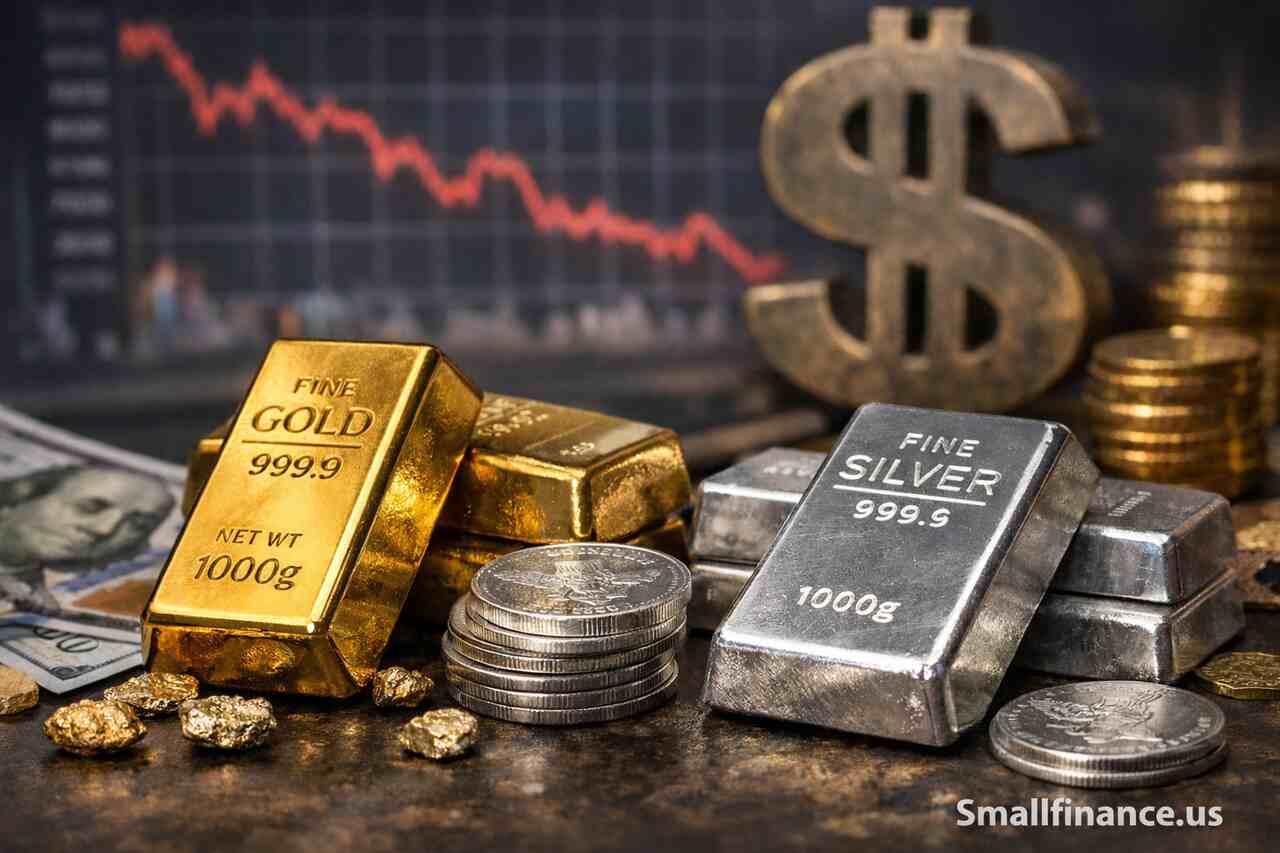
Gold and silver prices ended the week on a softer note as a stronger U.S. dollar and shifting expectations around Federal Reserve interest rates weighed on the precious metals complex. Even with geopolitical tensions and inflation concerns still present, investors have recently favored the dollar and Treasury yields over traditional safe-haven assets.
As of the latest trading on Friday, spot gold was around $5,052 per ounce, while spot silver traded near $81 per ounce in global markets. U.S. gold futures for April delivery settled close to $5,061 per ounce as the market headed into the weekend.
The pullback comes after an extraordinary rally earlier this year that pushed gold to record highs near $5,600 in late January.
What Is Moving the Market
The biggest driver of the current price action is the strength of the U.S. dollar. When the dollar rises, gold typically struggles because the metal becomes more expensive for investors holding other currencies.
At the same time, rising inflation concerns linked to higher energy prices are complicating the Federal Reserve’s policy outlook. If inflation remains sticky, the Fed may delay interest rate cuts, keeping yields elevated and reducing the appeal of non-yielding assets such as gold.
Geopolitical tensions involving the Middle East are also creating a complicated backdrop. While conflict normally boosts safe-haven demand for gold, the dollar has recently absorbed more of that demand as investors seek liquidity and stability in U.S. assets.
In other words, the market is currently balancing three competing forces: geopolitical uncertainty, inflation risk, and monetary policy expectations.
Gold Market Analysis
Gold’s retreat toward the $5,050 area reflects a period of consolidation following one of the strongest bull runs the metal has experienced in decades.
Prices surged earlier this year as investors sought protection from geopolitical instability and long-term inflation risks. At one point in January, gold briefly touched an all-time high near $5,594 per ounce, highlighting the extraordinary strength of the rally.
In my view, what we are seeing now looks less like the end of the bull market and more like a pause. Markets often consolidate after such aggressive moves as traders lock in profits and reassess macro conditions.
From a technical perspective, the $5,000 level has become an important psychological support area. If gold holds above that level, the broader bullish structure of the market likely remains intact.
However, if the dollar continues strengthening and Treasury yields move higher, gold may remain range-bound in the short term.
Silver Market Analysis
Silver has been even more volatile than gold in recent weeks.
Unlike gold, silver has a strong industrial component tied to sectors such as electronics, solar energy, and manufacturing. Because of that, silver tends to react not only to safe-haven demand but also to shifts in economic growth expectations.
With spot prices near $81 per ounce, silver remains historically elevated but has seen larger percentage swings than gold during recent market moves.
That volatility is typical for silver. When precious metals rally strongly, silver often outperforms gold. But when macro conditions shift and risk sentiment weakens, silver usually falls faster.
From what I’m seeing in the market right now, silver is essentially acting as a high-beta version of the gold trade. If gold stabilizes and moves higher again, silver could rebound quickly.
My View as a Metals Analyst
Based on my experience tracking precious metals markets, this looks like a classic consolidation phase after a major rally.
Gold and silver surged earlier this year due to geopolitical risks, strong central bank demand, and expectations that global interest rates would eventually decline. Those structural drivers have not disappeared.
What has changed in the short term is the strength of the dollar and uncertainty about how quickly the Federal Reserve will move toward rate cuts.
If inflation remains elevated and rate cuts are pushed further out, metals could stay volatile for a while.
Key Catalysts to Watch
The next major catalysts for gold and silver will likely come from U.S. economic data and central bank signals. Investors are closely watching inflation readings, labor market reports, and Federal Reserve commentary for clues about the path of interest rates.
Movements in the U.S. dollar index and Treasury yields will also remain critical. Even small shifts in those markets can have an outsized impact on precious metals prices.
Short-Term Outlook
In the near term, gold appears to be stabilizing just above the $5,000 level as traders reassess macroeconomic conditions.
Silver is likely to remain more volatile, moving sharply alongside broader commodity sentiment and economic expectations.
My base case right now is continued choppy trading as investors wait for clearer signals from the Federal Reserve and upcoming economic data.
If the dollar weakens or rate-cut expectations return, both gold and silver could quickly regain upside momentum.
Read Next: Gold Hits $5,000 as Talks Between Russia and Ukraine Come to a Standstill; Oil Jumps
