

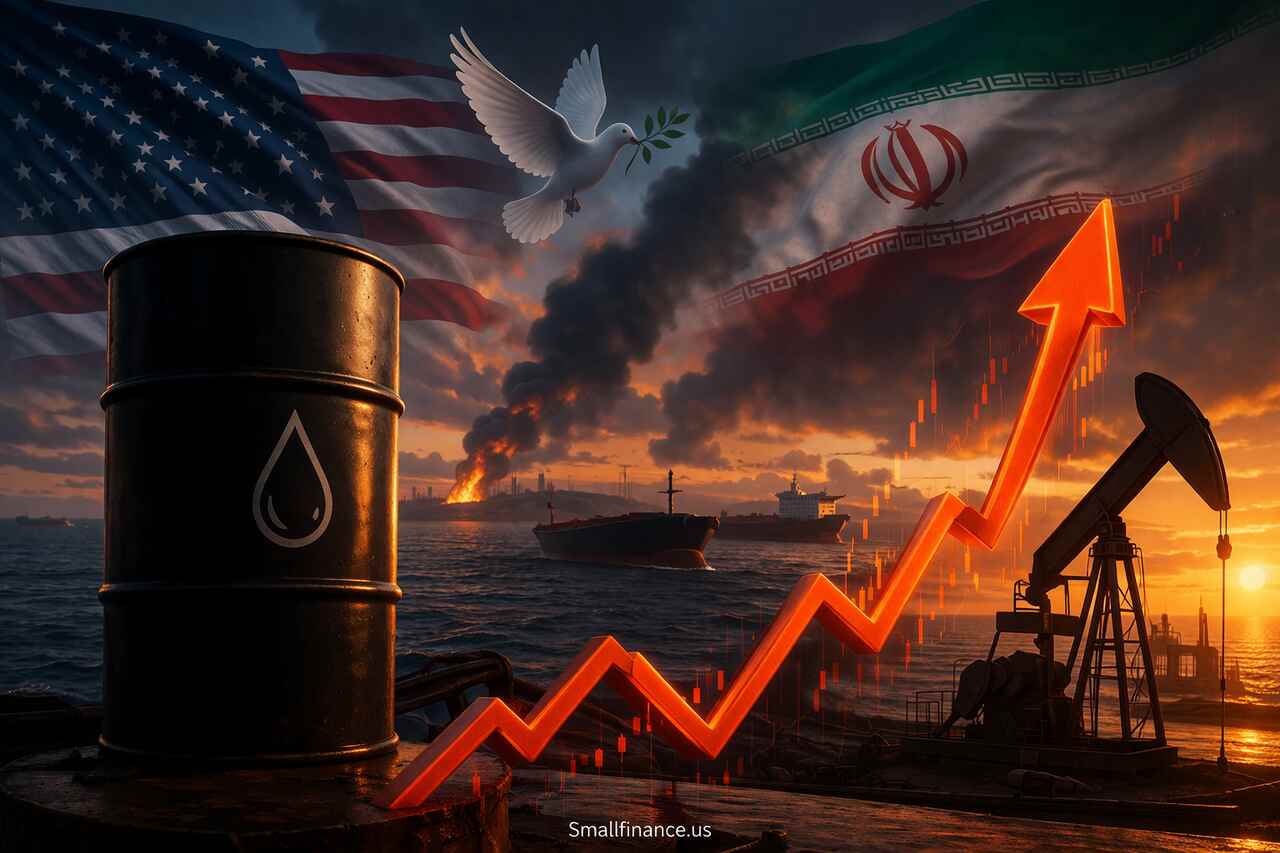
After Israel launched a series of strikes on Lebanon, worries over the sustainability of a precarious US-Iran ceasefire have led to an increase in global oil prices.
US President Donald Trump has stated that US forces will stay in the area until Iran complies with the “real” ceasefire agreement, while Tehran has threatened a “regret-inducing response” if the attacks continue.
Following the announcement of a deal to halt hostilities, which included the reopening of the vital Strait of Hormuz waterway, oil prices fell on Wednesday.
However, fears of a protracted disruption to oil supplies have been rekindled by reports that Iran stated the vital maritime route will remain closed due to Israeli raids.
As pressure intensified on what Vice President JD Vance called a “fragile truce,” US-traded West Texas Intermediate was up 2.8% at $97.02, while global benchmark Brent crude increased 2% to $96.53 per barrel.
Additionally, some of the significant gains gained by stock markets on Wednesday were reversed. In Europe, the UK’s FTSE 100 down 0.4%, Germany’s Dax index fell 1.3%, France’s Cac fell 0.8%, and Japan’s Nikkei 225 index closed down 0.5%.
The head of investment at Interactive Investor, Victoria Scholar, told the BBC’s Today program, “I think there’s a little bit of nervousness in global markets.” “Markets are giving back some gains… and I think that reflects a lot of uncertainty over whether the Strait of Hormuz is actually open.”
The flow of energy exports via the strait will be the main focus in the next days, according to Sim Moh Siong, strategist at Singaporean bank OCBC, while it is yet unclear how Tehran intends to regulate the movement of vessels.
The peaceful passage of ships across the Strait of Hormuz was one of the terms of the ceasefire agreement.
The shipping brokerage company SSY has confirmed to BBC Verify that Iran’s navy has warned ships in the Gulf that any vessels attempting to transit the Strait of Hormuz without authorization “will be targeted and destroyed”.
Since the agreement was made public, only few ships have traversed the channel; this is far less than the 130 ships that did so every day prior to the conflict.
According to marine surveillance company Pole Star Global, even if the strait resumes its regular amount of trade, it will take at least ten days to clear the current backlog of vessels.
Malaysia, India, and the Philippines are among the nations that have arranged safe passage for its ships in recent weeks.
“It is very difficult to plan because every day you get very different news,” stated Nils Haupt of Hapag-Lloyd, a container shipping company that still has six ships in the Persian Gulf.
“Wednesday, yesterday, was an ordinary day. He told the Today program, “You get the news, ‘it will now be open and something is happening now’, and then in the evening it is not happening.”
“If this means that for the coming years there will be a fee for the Strait of Hormuz of millions which is double, triple the price of crossing the Panama Canal or the Suez Canal it would be quite ridiculous for the entire industry,” Haupt cautioned, adding that they were still awaiting official word on whether there would be fees to cross the Strait.
Whether Lebanon is covered by the ceasefire is a matter of debate.
At least 182 people were killed when Israel conducted its most intense bombardment of the nation throughout this conflict on Wednesday.
In a social media statement, Hezbollah claimed to have fired missiles against northern Israel. According to the militia supported by Iran, it was a reaction to ceasefire violations.
