


I am Jordan, and I’m excited to share how Artificial Intelligence has transformed the way I run my small business. Like many entrepreneurs, I used to juggle multiple roles—handling customer service, marketing, accounting, and more. Over time, managing everything became overwhelming until I started using AI tools to automate repetitive tasks, predict customer behavior, and optimize daily operations. What seemed like a tech trend for large corporations turned out to be a game-changer for small businesses like mine. I’m sharing how AI can work for you, too.
Highlights:
-
Automates Repetitive Tasks: AI reduces manual workload in accounting, HR, and customer service.
-
Boosts Customer Engagement: Personalized marketing and chatbots improve retention and satisfaction.
-
Increases Sales Efficiency: AI-driven CRM tools prioritize leads and forecast revenue more accurately.
-
Reduces Operational Costs: Automation and predictive tools streamline processes and cut unnecessary expenses.
-
No Tech Skills Required: Most AI tools are no-code and designed for easy use by non-technical users.
-
Improves Decision-Making: Real-time analytics help small business owners make faster, data-backed decisions.
-
Affordable & Scalable: AI tools are now budget-friendly with plans tailored for small businesses.
-
Future-Proof Growth: AI adoption positions businesses for long-term innovation and market competitiveness.
Introduction:
Artificial Intelligence (AI) enables small businesses to optimize operations, personalize customer experiences, and automate repetitive tasks without requiring large enterprise budgets. AI supports key areas such as predictive analytics, customer relationship management, process automation, and content generation. By integrating AI tools strategically, small business owners can compete with larger corporations by improving decision-making speed, enhancing service delivery, and lowering operational costs. This article explains how AI technologies function across core business areas and explores their benefits, tools, and implementation strategies tailored specifically for small businesses.
How Does AI Improve Small Business Operations?

AI enhances small business operations by automating manual tasks, optimizing workflows, and providing real-time insights. Automation reduces human error and increases consistency across departments such as inventory, HR, sales, and marketing.
Business Process Automation
AI-driven automation tools perform repetitive tasks such as data entry, invoice generation, appointment scheduling, and order processing. AI bots follow predefined rules or learn from patterns, reducing human workload and increasing operational accuracy.
-
Invoice Processing: AI automates invoice matching and flagging discrepancies.
-
Appointment Scheduling: AI chatbots manage bookings and send confirmations.
-
Document Management: OCR-based AI systems scan, sort, and file documents.
-
Inventory Management: AI predicts inventory shortages and automates restocking.
Predictive Analytics for Decision-Making
Predictive analytics helps small businesses forecast trends, customer behavior, and resource needs. AI models analyze historical data to provide actionable business insights.
-
Sales Forecasting: AI predicts seasonal demand patterns.
-
Customer Churn Analysis: AI flags at-risk customers before they leave.
-
Market Trend Analysis: NLP-based AI tracks industry sentiment across online channels.
-
Financial Risk Assessment: AI analyzes credit scores and spending patterns for loan decisions.
Workflow Optimization
AI tools streamline workflows by identifying bottlenecks and suggesting process improvements. These tools integrate with CRM, ERP, and project management systems.
-
Task Prioritization: AI categorizes tasks based on urgency and importance.
-
Team Collaboration Tools: AI recommends optimal task assignments and deadlines.
-
Customer Support Routing: AI routes customer queries to the most suitable agent.
-
Time Tracking Automation: AI monitors work patterns and optimizes schedules.
Human Resource Automation
AI supports recruitment, employee engagement, and HR compliance with minimal manual intervention.
-
Resume Screening: AI filters candidates based on job descriptions and required skills.
-
Chatbots for HR Queries: AI bots answer employee questions about policies and benefits.
-
Performance Analytics: AI tracks employee productivity and KPIs.
-
Training Recommendation Systems: AI suggests upskilling paths based on employee roles.
AI Tools vs Operational Functionality
| AI Tool Name | Operational Function | Use Case Example | Business Benefit |
|---|---|---|---|
| QuickBooks AI | Accounting Automation | Invoice categorization and payment reminders | Reduces accounting hours by 40% |
| Tidio Chatbot | Customer Communication Automation | Auto-reply to website visitors | Improves customer response time |
| Zoho CRM AI | Sales and Lead Management | Predictive lead scoring | Increases conversion rate |
| Pecan AI | Predictive Analytics | Sales and inventory forecasting | Minimizes overstock and stockouts |
| Clockwise AI | Time Optimization | Calendar management | Enhances employee time efficiency |
Read also: Dell Secures $5 Billion AI Server Deal with Elon Musk’s xAI: Powering the Future of AI
Artificial Intelligence reduces manual workloads, predicts outcomes, and aligns operational decisions with business goals. Each tool provides data-driven insights that are valuable even for non-technical business owners.
How Can AI Improve Customer Experience for Small Businesses?

AI improves customer experience by enabling personalized communication, faster response times, and proactive service delivery. Small businesses can provide 24/7 support and tailored product recommendations using AI technologies.
AI Chatbots and Virtual Assistants
AI chatbots provide instant answers to frequently asked questions. They work across platforms like websites, WhatsApp, and Facebook Messenger.
-
24/7 Availability: AI ensures customer support outside business hours.
-
Multilingual Support: NLP-based bots handle multiple languages.
-
Query Resolution: AI categorizes and solves common support issues.
-
Live Agent Handoff: AI escalates complex queries to human agents.
Personalized Marketing Campaigns
AI analyzes customer data to create hyper-personalized marketing messages that increase engagement and sales.
-
Email Automation: AI sends product suggestions based on purchase history.
-
Ad Targeting: AI segments audiences for more effective social media campaigns.
-
Behavioral Analysis: AI tracks browsing patterns to personalize offers.
-
Campaign Timing Optimization: AI identifies the best time to send promotions.
Sentiment Analysis
Sentiment analysis tools interpret customer reviews and social media comments to gauge satisfaction.
-
Review Monitoring: AI detects positive or negative sentiment in online feedback.
-
Brand Perception: AI compares sentiment trends over time.
-
Complaint Flagging: AI automatically prioritizes negative reviews for immediate response.
-
Product Feedback: AI identifies popular or disliked features from comments.
Voice Recognition and AI Calls
AI-powered voice assistants and smart IVRs manage phone-based interactions with customers.
-
Voice-to-Text Transcription: Converts customer calls into searchable text logs.
-
Automated Phone Menus: Directs customers without human intervention.
-
Speech Sentiment Detection: Recognizes frustrated or happy tones in customer calls.
-
Voice Authentication: Verifies user identity through biometric voiceprints.
What Are the Best AI Tools for Small Businesses?
Small businesses benefit from AI tools that are affordable, scalable, and easy to integrate. These tools enhance productivity without requiring deep technical knowledge.
Customer Relationship Management (CRM)
AI-enhanced CRMs help businesses manage leads, automate communication, and close sales more efficiently.
-
HubSpot CRM: Includes AI email tracking, lead scoring, and chat support.
-
Zoho CRM: Uses Zia AI for anomaly detection, smart alerts, and sales forecasting.
-
Pipedrive: Suggests next steps in the sales funnel automatically.
-
Freshsales: Automates customer segmentation and follow-ups.
Marketing and Content Creation
AI simplifies content generation, SEO optimization, and ad copywriting.
-
Jasper AI: Writes blog posts, product descriptions, and emails.
-
Copy.ai: Generates slogans, value propositions, and ad text.
-
SurferSEO Optimizes content using NLP-based scoring systems.
-
Writesonic: Assists in writing high-converting landing pages.
Customer Support Tools
AI-driven support tools manage tickets, FAQs, and direct interactions.
-
Tidio: Combines live chat with AI automation.
-
Intercom: Offers AI-based resolution bots and help desk integration.
-
Drift: Identifies qualified leads via conversational AI.
-
Zendesk AI: Analyzes support tickets to suggest responses.
Finance and Accounting
AI accounting tools track expenses, automate reporting, and ensure compliance.
-
QuickBooks: Uses machine learning for categorization and fraud detection.
-
Xero: Automates bank reconciliation and invoice approvals.
-
Expensify: Captures receipts using OCR and tracks reimbursement.
-
Bench AI: Provides AI-powered bookkeeping support for small businesses.
What Are the Benefits and Limitations of Using AI in Small Businesses?
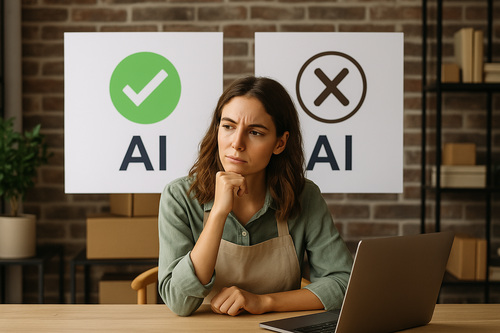
AI provides measurable advantages but also requires careful implementation to avoid risks or inefficiencies.
Key Benefits
-
Cost Reduction: Automation lowers labor costs significantly.
-
Increased Revenue: Personalized marketing increases sales conversions.
-
Faster Decision-Making: AI accelerates access to business insights.
-
Customer Satisfaction: 24/7 service improves loyalty and engagement.
Limitations and Risks
-
Data Privacy Concerns: AI requires access to sensitive business and customer data.
-
Initial Learning Curve: Small business owners may need training to implement AI tools.
-
Over-Reliance on Automation: Blind trust in AI can lead to misjudgments if not supervised.
-
Tool Compatibility: Some AI tools may not integrate well with existing systems.
What Is the Future Scope of AI in Small Businesses?
AI adoption among small businesses is expected to rise as tools become more affordable, secure, and no-code. Integration with edge computing, real-time analytics, and generative AI will unlock deeper personalization and smarter automation.
Emerging Trends
-
No-Code AI Platforms: Tools like Bubble and Peltarion allow building AI workflows without programming.
-
Voice and Image Recognition: Expanding use in customer verification and quality control.
-
Real-Time Translation: AI tools will help businesses expand to multilingual markets.
-
AI Agents: Multi-modal agents will handle full customer conversations across voice, text, and chat.
Conclusion:
AI empowers small businesses to operate more efficiently, engage customers meaningfully, and make smarter decisions. From automating routine processes to delivering predictive insights, AI transforms how small businesses compete in dynamic markets. With affordable tools and minimal setup requirements, business owners can confidently integrate AI across departments for sustainable growth, higher productivity, and long-term profitability.
FAQ:
Q1: Can small businesses afford AI tools?
Yes, many AI platforms offer free tiers or scalable pricing designed for small businesses.
Q2: Do I need coding skills to use AI in my business?
No, most modern AI tools are built for non-technical users with drag-and-drop interfaces or integrations.
Q3: What areas should I start with if I’m new to AI?
Begin with automating customer service, lead generation, and simple marketing tasks.
Q4: Is AI secure for handling customer data?
Yes, if tools follow GDPR or other compliance standards. Always check the vendor’s security policies.
Q5: How fast can I see results after integrating AI?
Most businesses observe improvements within weeks in customer engagement and workflow efficiency.
