

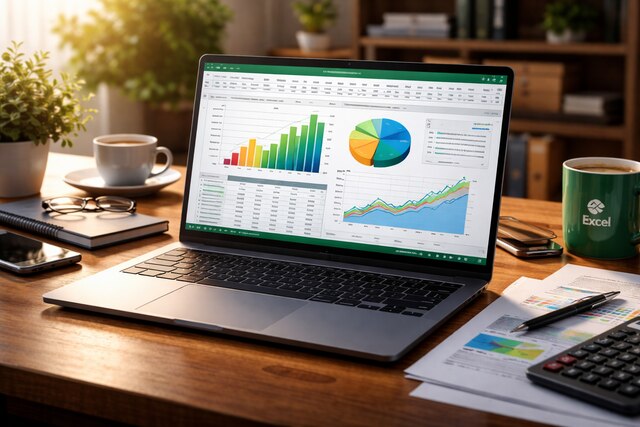
Some computer games in the 1990s had a “boss key” that let people open an Excel spreadsheet if they needed to look busy.
Now, if a worker is seen working on a spreadsheet, their supervisor might not like it. Microsoft owns Excel, which is 40 years old. Some IT leaders think it’s, at best, a hindrance to easier digital workflows and AI, and at worst, an accident waiting to happen.
In the business world, Excel is everywhere. Acuity Training’s study shows that two-thirds of office workers use Excel at least once each hour.
Tom Wilkie, chief technology officer of data visualization company Grafana, believes that Excel is still popular because it is being used in technical education along with Word and PowerPoint.
“Excel is a great tool.” He explains, “There’s nothing better for quick and easy analysis than this if you want to look at a small dataset, try an idea, or make a quick chart for a presentation.”
Prof. Mark Whitehorn, an emeritus professor of analytics at Dundee University, says that the problem is that consumers and organizations don’t know the difference between processing data and analyzing and visualizing it.Whitehorn says, “There are all these small departments where data comes in, goes into a spreadsheet, is run through macros, and it spits out the other end.”
You can think of a macro as a quick way to do something. It automates a number of tasks on the spreadsheet, so you only have to click once to follow the instructions. For instance, it can format the data in a certain way or do math.
Whitehorn goes on to say that “spreadsheets are often poorly documented and maintained,” and “the guy who wrote the macros has left, and the people in the department don’t know how to run them.”
He believes that more practically, it means that data in a business isn’t controlled from one place. This makes it challenging to protect and move data around the company, or to get it out for more in-depth study and to power AI.
This can make it so that very vital tasks depend on unstable spreadsheets.
It came out last year that Health New Zealand used an Excel spreadsheet as its “primary data file” to keep track of and analyze its financial performance.
This made it impossible to gather and combine data, caused mistakes and discrepancies, and made it hard to get a real-time picture.
In 2023, the hiring procedure for anesthetists in the UK was thrown into chaos by spreadsheet confusion. The Afghan data crisis happened after an Excel spreadsheet was shared.
But it’s hard to encourage people and teams to stop using Excel.Moutie Wali, director of digital transformation and planning at Canadian telecoms company Telus, says, “It’s hard for an outside vendor or tool provider to just give the organization something that all of those teams could use.”
He has led an effort to move hundreds of employees from Excel to a proprietary planning system.
The goal is to make it easier to manage and integrate data, add more automation, and use AI.
But people wanted to preserve their previous Excel installations and simply download information from the new system, Wali explains. “I said no way. You have to make it happen by not letting the spreadsheet work with your [new] apps.
A Microsoft spokeswoman states, “Over four decades, Excel has evolved from a basic spreadsheet into a versatile platform used by everyone.”It is used more than ever before, with monthly usage steadily increasing over the previous six years. It is still the default tool for reporting, modeling, and analyzing data in all industries.
Rethinking how much you depend on Excel can help more than just big businesses. Kate Corden runs Hackney Bike Fit, a bike fitting service. This means she has to keep track of two sets of data: one set of personal information about a customer, such their height, weight, and flexibility, and another set of information about the bikes.
She knows a lot about Excel because she used to be a business development manager in the corporate sector. But she believes, “It’s too easy to lose data.” It’s not hard to change data.
Corden turned to LinkSpace, which was originally made to help handle cases but can also be changed to deal with complicated workflows. “Having a full data management system with everything in one place, instead of having a lot of excels, is going to really help me as I grow.”
And the possible benefits of getting rid of Excel go beyond just making it easier to manage data.
Julian Tanner is a public relations executive in London and the treasurer of a local charity. He moved the charity’s books from Excel to an internet accounting program that pulls data from invoices.
The package has AI built in, so you can get personalized reports with only one click.
They could also do rid of the need for a bookkeeper, which saved them more than £6000 a year. “It cost a lot for a charity,” Tanner adds, “which you always try to avoid.”
For larger businesses, the benefits include smoother workflows and data that is collected and standardized so that it may be used in AI or machine learning systems.
Wali thinks that getting rid of misaligned capital will save them C$42 million ($30 million; £23 million) a year, in addition to making data integration easier and planning cycles faster. Other Telus teams are now thinking about doing the same thing.
But that means consumers have to be ready to give up some control, or at least the idea of control.Whitehorn said that people will say, “I’m taking my data and doing this.” But, “The data belongs to the company, not you.”
It may not be possible to get rid of Excel completely. Whitehorn says that the boss key may need to be changed in the future to hide the fact that people are using spreadsheets.
