

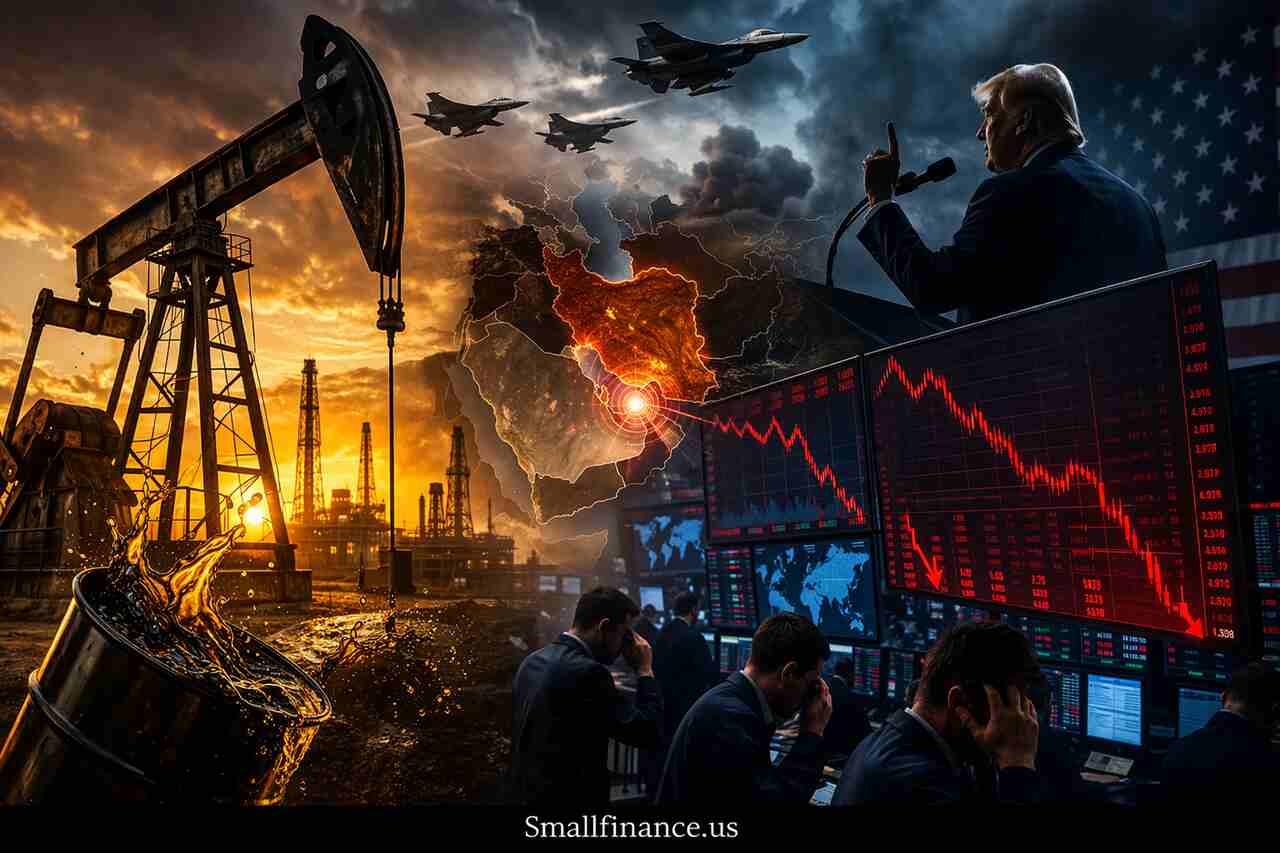
After US President Donald Trump said again that he would hit Iran “extremely hard” in the coming weeks but didn’t say how the war will end, oil prices started going up again.
After Trump’s speech from the White House, stock markets in the US, Europe, and Asia all went down, and Brent crude briefly went above $109 (£82) a barrel.
He stated that the US would soon finish its war goals and would then spend the next two to three weeks bombing Iran “back to the Stone Ages.”
Before Trump’s speech, oil prices fell below $100 in hopes that he would talk about how the US would leave the war. Instead, he just repeated what he had already said.
The war in Iran has made it very hard for the world to get oil and gas.
Most oil shipments through the Strait of Hormuz have stopped since Iran said it would attack ships that try to cross in response to the strikes that started on February 28 by the US and Israel.
In his speech, Trump said that the US did not need oil from the Middle East. He also asked other countries to help free up shipments from the Gulf that have been held up by the war.
He said: “To those countries that can’t get fuel, many of which refuse to get involved in the decapitation of Iran… build up some delayed courage, go to the Strait and just take it.”
Oil prices, which had been going up and down slowly before the speech, shot up right after it was shown on TV.
The world standard, Brent crude, went up more than 8% on Thursday before going down a little.
The US benchmark, West Texas Intermediate, which had been less affected by price increases earlier in the war than Brent, also took off. It briefly traded above $110 a barrel in New York trade on Thursday morning before easing back a bit.
For Alberto Bellorin, founder and managing director of oil and gas consulting firm InterCapital Energy, the rise was a “clear market reality check” after earlier hopes for a quick end to the fighting.
Trump didn’t give a “concrete timeline” for when the Strait of Hormuz would reopen in his speech. He also said that things look like they will be back to normal in “months rather than weeks.”
Bellorin said that Trump’s call for other countries to help has dashed dreams that problems with the world’s energy supplies will be fixed quickly.
Trump said in his speech that oil and gas flows would start up again quickly after the war was over.
The strait will open up on its own when this war is over. “It will open up on its own,” he said.
But Anne-Sophie Corbeau, who used to be the head of gas research at BP, said that flows might not be back to normal for a while.
Oil and gas infrastructure in the Gulf has been harmed by attacks by Iran, Israel, and the US. Corbeau said it could take three to five years to fix.
Corbeau, who is now at the Center on Global Energy Policy at Columbia, told BBC’s Today that traffic problems through the Strait of Hormuz were likely to last for a while and that fees to use the strait could add up to “quite substantial” costs.
She said that as of now, she thought ships had to pay around $2 million to use the strait, which, if made permanent, would be “the worst-case scenario” for people who use the canal.
When the market finished in the US, the S&P 500 and Nasdaq were both slightly higher, up 0.1% and 0.2%, respectively, after going down earlier. At the end of trade, the Dow Jones Industrial Average was down 0.1%.
In the UK, the FTSE 100 index went down in the early afternoon, but it ended the day up 0.69%. Both France’s Cac index (0.24%) and Germany’s Dax (0.79%) went down at the end of the day, making up for some losses they had earlier.
In Asia, the big stock indexes went down after Trump’s speech, going against earlier gains.
Japan’s Nikkei 225 fell 2.4% at the end of the day, and South Korea’s Kospi fell 4.5%.
Since the Iran war started, the stock markets in the area have been very unstable.
Asia is especially vulnerable to the effects of the war because it gets a lot of its energy from the Middle East.
